

Labs, Clinical Notes, Forms, Patient Records, Integrations, Cohorts, and Access Controls
Label On-Site Lab Samples at Collection
Prevent specimen mix-ups from Labs by opening a submitted Junction order with On-site collection and clicking Print labels, which prepares tube labels with the collection time at the chair.Bring InBody Scans Into Patient Charts
Save manual entry by connecting InBody under Settings → Clinical, so LookinBody body-composition scans match to patients and appear automatically in their Measurements.Turn Documented Work Into Checkout Items
Save providers from re-entering services and products by letting AI Scribe fill a note’s Today’s Items from what was performed or sold in the consultation, ready for Billing → Payment Check-out.Carry Correct Item Quantities Into Checkout
Prevent underbilling from a clinical note’s Today’s Items field by setting each service, product, package, or gift card quantity there, which carries the same count into Billing → Payment Check-out.Review AI Changes Inside Each Editor
Save setup time by opening Ask Decoda while editing a form or note template, reviewing its field and section suggestions in place, and choosing which changes to keep before Save.Protect Patient Forms on Shared Devices
Keep clinic records private during in-person form filling by setting Staff PIN under Settings → My Decoda → Profile, which is required before leaving the patient form and returning to Decoda.Require Clear Answers to Consent Questions
Reduce ambiguous consent records under Settings → Patient Experience → Forms by turning on Required for a mapped consent question, which makes patients choose Yes or No without forcing agreement; see Patient Data Mapping.Control Who Manages Document Types
Protect clinic-wide document categories by granting Manage Document Types under Settings → Staff → Roles & Permissions → Settings only to staff who should add, rename, or remove types during patient document uploads; see Document Types.Manage Document Types With Ask Decoda
Save settings work by using Ask Decoda about your settings to propose adding, renaming, or archiving clinic document types, then review the changes before applying them.Focus Cohort Reviews on Relevant Details
Review outreach audiences faster under Patients → Cohorts by opening a filter-based cohort and using Columns to show only the patient, appointment, spending, location, source, credit, and consent details you need.Limit Patient Details Sent to Integrations
Reduce unnecessary PHI sharing under Settings → Growth → API & Webhooks by editing a webhook’s Patient details and choosing Leave out patient names, email addresses, and phone numbers, while keeping patient and appointment IDs for matching.Separate Fax Sending From Contact Changes
Keep fax access aligned with each role by granting Manage Fax Contacts under Settings → Staff → Roles & Permissions → Messaging only to staff who should add, edit, or remove contacts in Comms → Fax → Contacts; see Fax Contacts.Analytics, Billing, Forms, Communications, and Workflow Improvements
Compare Appointment Performance by Service Category
Spot which parts of your catalog drive volume and value under Analytics → Appointment Dashboard by choosing Category in Group by, which divides multi-category appointment value by service count; see Appointment Analytics.See Why Clinical Work Is Incomplete
Clear follow-up work faster under Analytics → Appointment Dashboard → Activity with Clinical gaps, which names missing check-in, forms, notes, or care plan steps on each appointment; see Activity.Prevent Membership Benefits From Over-Discounting
Protect margins under Settings → Catalog → Memberships → Benefits by clearing Can be combined with other discounts, so checkout applies either that benefit or the other discounts—whichever saves the patient more; see Benefits.Keep Checkout Services and Appointments Aligned
Prevent record mismatches on Billing → Payment Check-out by choosing Update appointment on the success screen when a sold service is missing from the linked appointment, with Checkout appointment updates under Settings → My Decoda → Preferences → Calendar controlling future prompts; see Preferences.Verify Checkout Details Before Moving On
Catch billing mistakes before leaving Billing → Payment Check-out with an itemized success screen that shows items, discounts, taxes, tips, payment methods, cash discounts or surcharges, and payment-plan terms.Keep Patient Form Progress Through Interruptions
Prevent patients from repeating intake work by saving each section when they click Continue on a patient form link and returning them to the latest section when they reopen it within four hours; see Partial Submissions.Send Every Form Linked to a Service
Save staff from selecting intake paperwork one form at a time from a patient’s Forms → Send to Patient window by turning on Choose by service, selecting a service, and sending all of its active linked forms together; see Sending Forms.Build Outreach Sequences With Ask Decoda
Save setup time from Settings with Ask Decoda about your settings, which can draft, update, pause, activate, or archive outreach sequences for review before you apply them; see Sequences.Control Who Can Start Website Chats
Match website chat access to your clinic’s policy under Settings → Patient Experience → Web Chat by turning Guest chat on for all visitors or off to require sign-in; see Anonymous Guest Chats.Catch Cash Drawer Differences at Close
Spot cash discrepancies as soon as a register closes by turning on Register Closed under Settings → My Decoda → Notifications → Cash Drawer Alerts, which includes the closing amount and over-or-short difference; see Cash Drawer Alerts.Online Sales, Scheduling, Patient Engagement, Clinical, Catalog, and Billing Improvements
Build More Flexible Volume Promotions
Protect margins on complex offers under Settings → Growth → Promotions by choosing a Pricing method for each Graduated tier, mixing Fixed price per unit and Percentage off list price in one schedule; see Graduated Pricing.Reach Every Patient With Review Requests
Expand review outreach from a message blast or sequence by inserting Review Link, which gives every patient a working link even without a past appointment; see Reviews.Target Today’s Birthdays Without Date Edits
Save daily outreach setup in Patients → Cohorts by choosing is today for Birthday or Membership Anniversary, which recalculates whenever the cohort runs; see Birthday Filters.Sell Memberships Through Your Online Shop
Grow recurring revenue by letting patients add a membership to the Online Shop cart and complete its enrollment, required form, and payment in the same purchase.Control Which Memberships Patients See Online
Keep online enrollment focused under Settings → Patient Experience → Shop by showing, hiding, previewing, and ordering membership plans alongside the rest of your catalog.Turn New Membership Benefits Into Bookings
Help patients use new membership benefits by showing Book [service] or Book an appointment immediately after enrollment in the Patient Portal or Online Shop.Keep Custom Gift Cards On Brand
Keep flexible gifting on brand by turning on Allow custom pricing for a named card under Settings → Catalog → Gift Cards, which lets patients choose its value in the Online Shop.Cancel Appointments Directly From the Calendar
Save scheduling time in Check-In → Calendar by right-clicking an appointment and choosing Cancel appointment, while keeping the usual reason, patient message, recurrence, and fee choices; see Cancel an Appointment.Choose Service Add-Ons While Booking
Keep staff-booked visits accurate by selecting and revising Add-ons from each service on the appointment timeline, with duration and card requirements included automatically; see Add-Ons on a Booking.Book Repeated Add-Ons With Correct Timing
Keep multi-area visits timed correctly by using + and – beside an appointment Add-on to book it more than once, with each selection added to the timeline; see Add-Ons on a Booking.Focus Shift Planning on Selected Teams
Review the right staff faster under Settings → Scheduling → Shifts by using Selected Teams to narrow the calendar while keeping location and staff filters in place.Order Payment Terminals Without Leaving Decoda
Set up in-person payments faster by choosing and purchasing hardware on the Card terminal setup step or from Settings → Billing → Payment Management → POS Devices; see Order a Device.Start Package Expiry at First Use
Give patients their full package window under Settings → Catalog → Packages → Expiration by choosing At first redemption for Start the clock, so the countdown begins when they use a benefit; see Package Expiration.Reuse Compound Medication Recipes Across Visits
Reduce repeated dose setup under Settings → Catalog → Medications by marking a medication This is a compound and saving its components once for dosing, inventory, and checkout; see Compound Medications.Capture Clinical Dates and Times Together
Record precise clinical timestamps from Settings → Clinical → Note Templates by turning on Include a time for a Date question; see Configure Each Field.Summarize Repeated Measurements by Time Period
Make frequent readings easier to interpret on a patient’s Measurements section by choosing No grouping, Day, or Week and combining values with Sum, Average, or Latest; see Review Trends and Goals.Keep Tips With Eligible Staff
Prevent misassigned gratuities under Settings → Staff → Users by clearing Can receive tips for staff who should not appear at checkout or on the patient tip screen; see Tip Eligibility.AI Calling, Scheduling, Growth, Forms, Labs, and Billing Improvements
Match AI Calls to Your Clinic
Give callers a consistent clinic experience by choosing and previewing a Voice for each assistant under Settings → Assistants → Phone Numbers; see AI Assistants.Send Telehealth Links From Each Appointment
With a clinic or provider Google Calendar connected, save coordination time in Check-In → Calendar by choosing Send Telehealth link on an appointment, which creates a Google Meet link and opens a patient chat with the message ready to review.Keep Ad Leads Ready for Follow-Up
Keep new leads eligible for timely outreach when a connected Meta or Google lead form adds or reopens an opportunity in Growth → Opportunities, carrying its SMS and email marketing permission into Decoda automatically.Reuse Membership Fees in Patient Forms
Reduce membership agreement setup under Settings → Patient Experience → Forms by inserting Early Cancellation Fee and Non-Refundable Amount from the selected plan; see Membership Details.Review Ready Lab Results Without Checking
Save providers from repeatedly checking a patient’s Labs tab by turning on Lab Results Ready under Settings → My Decoda → Notifications → Lab Alerts, then opening each alert directly to the results; see Labs.Calculate Tips From Each Provider’s Services
Keep multi-provider tips accurate by turning on Provider-specific tipping under Settings → Billing → Payment Management → Tips, which asks about each provider separately and bases percentage choices on their attributed items; see Tip Screen.Settings, Clinical Workflow, Notes, Growth, and Communications Improvements
Understand Clinic Settings Without Hunting Through Menus
Save setup time under Settings by using Ask Decoda about your settings to check your clinic’s current configuration and find the exact page where you can make a change.Target Service Sequences With Saved Cohorts
Keep automated follow-up relevant under Settings → Scheduling → Services → Sequences by adding Patient is in cohort or Patient is not in cohort to a step; see Service Sequences.Act on New Leads Without Delay
Follow up before leads go cold by turning on New Lead, Lead Moved Stage, Lead Won, Lead Lost, Lead Assigned, or Lead Note Added under Settings → My Decoda → Notifications → Growth & Pipeline Alerts; see Growth & Pipeline Alerts.Limit Patient Review Access by Role
Protect sensitive feedback by granting View Reviews under Settings → Staff → Roles & Permissions → Reviews only to staff who should open Growth → Reviews or see ratings on the patient chart; see Reviews Permissions.Complete Measurement Checklists While Recording Vitals
Prevent duplicate checklist work by recording the requested vital or measurement in an appointment’s Checklist, which completes the matching step automatically; see Appointment Checklists.Complete With Provider When Recording Starts
Keep an appointment’s Checklist accurate by starting an AI Scribe recording, which automatically completes the assigned provider’s With Provider step; see AI Scribe.Open Patient Context From Task Details
Save navigation time in a task’s details window by clicking the linked patient name to open the patient sidebar; see Linking to Patient Records.Track Patient-Sourced Medication Recommendations Clearly
Avoid mixing clinic-supplied and patient-supplied recommendations by choosing Recommended - Patient Sourced from a dose’s Update Status menu on the patient chart.Find Notes by Their Visit Date
Find the right chart faster on Notes by filtering with Visit Date, based on the linked appointment date or the note’s first-written date; see Filter and Search Notes.Format Clinical Notes for Faster Review
Make clinical notes easier to scan by selecting text in a long-form answer and applying Bold, Italic, Underline, headings, lists, quotes, or colors; see The Note Template Tab.Scan Long Notes With One Control
Review long clinical notes faster with Collapse all and Expand all above notes that use more than one section; see The Note Template Tab.Call Coworkers Directly From Desk Phones
Reach a coworker without transferring a patient call by dialing*8 plus a desk-phone extension from an idle handset; see Call Another Phone Directly.Catch Whispers When Decoda Is Hidden
Keep team messages moving while Decoda is in the background by selecting Enable under Settings → My Decoda → Notifications → Browser Notifications to show new Whispers as computer notifications.Billing, Patient Care, Inventory, Communications, Scheduling, and Growth Improvements
Answer Item Questions Directly on Quotes
Reduce quote follow-up by showing each catalog item’s description beneath its name in Billing → Quotes, while respecting Hide Item Descriptions.Find Quotes Faster With Precise Filters
Save billing review time in Billing → Quotes with patient-name search and filters for Quote ID, Patient ID, Quote Total, Created Date, and Location.Prevent Duplicate Charges During Checkout
Protect patient balances in Billing → Payment Check-out by marking today’s items as Already invoiced or Already paid and warning staff before they add them again.Add Tips and Credit From Checkout
Keep checkout in one workflow by adding a Tip or selling patient credit from the Other charges menu in Billing → Payment Check-out.Collect Outstanding Charges in One Checkout
Protect revenue in Billing → Payment Check-out by adding an Outstanding charge to the current ticket, with a warning before collecting a payment-plan balance in full.Clear Appointment Follow-Up Queues Faster
Work the right queue in Analytics → Appointment Dashboard → Activity by using Missing clinical for incomplete visit records and Missing payment for unpaid appointments; see Appointment Analytics.Keep Appointment Filters Across Every View
Review appointment performance consistently by using the same Providers, Locations, and Services filters across every Analytics → Appointment Dashboard tab; see Appointment Filters.Target Appointment Cohorts More Precisely
Reach the right patients from Comms → Blasts → Cohorts by limiting Has Appointment Between to selected services or appointment statuses; see Appointment Date Filters.Build Membership-Specific Patient Cohorts
Create focused outreach from Comms → Blasts → Cohorts with Membership Enrolled, Membership Anniversary, and Membership Status filters limited to selected plans; see Membership Filters.Schedule Membership Cancellations for Future Dates
Protect prepaid access and billing accuracy by choosing a future Cancellation Date from a patient’s Memberships actions menu.Protect Transactional Messages From Accidental Marketing
Reduce consent risk when activating a transactional sequence by confirming whether it contains marketing before messages can bypass marketing opt-in rules; see Activate a Sequence.Personalize Sequences With Appointment Details
Make follow-up messages more relevant by adding the patient’s last appointment date, provider, service, or review link to a sequence step; see Personalize Messages.Automate Pipeline Follow-Up With Sequences
Keep leads moving by attaching a multi-step sequence to a stage under Settings → Growth → Pipelines, with waits and email-based decisions between actions; see Stage Sequences.See Who Last Sent Each Email Thread
Improve communication accountability by checking Sent by on each row in Comms → Email → Sent, while the reading pane identifies who last sent from the thread.Capture Multiple Checklist Photos Together
Save appointment time by choosing Take Pictures in the check-in checklist to capture several photos and annotate each one before continuing.Put Past Appointments on Portal Home
Give patients faster access to recent visit details with a Past Appointments list on the patient portal home screen.Make Measurement Choices Easier to Understand
Make forms and notes clearer by adding a Display label to measurement options under Settings → Clinical → Measurements, such as0 - No pain; see Measurement Fields.Reuse Membership and Provider Details in Forms
Save form setup time by inserting membership plan, enrollment, provider, and saved-response details in Settings → Patient Experience → Forms; see Membership Details, Enrollment Details, and Provider Details.Keep Medication Records and Labels Accurate
Reduce medication record errors by choosing Prescribing Provider when adding a dose and Save Label when preparing a medication label; see Save or Print a Label.Control Who Can Skip Booking Fees
Protect deposit collection by granting Skip Booking Fees under Settings → Staff → Roles & Permissions → Scheduling only to staff who may clear a service’s booking fee while creating or editing an appointment; see Appointments.Carry Coverage Details Into Super Bills
Reduce insurance entry errors by setting a plan’s Coverage type under Settings → Billing → Insurance Carriers, which carries into patient coverage and Super Bills; see Insurance Carriers.Reuse Complete Carrier and Plan Details
Reduce repeated claims entry under Settings → Billing → Insurance Carriers by saving TSPID on the carrier and claims phone, notes, and active status on each plan; see Insurance Carriers.Cancel Inventory Counts Without Stock Changes
Recover quickly from a mistaken count by choosing Cancel count in Settings → Catalog → Stock → Take inventory, which discards the count without adjusting stock; see Cancelling a Count.Catch Low Provider Stock Earlier
Prevent treatment delays by setting Minimum Provider Allocation on stock and enabling the Low Provider Allocation alert under Settings → My Decoda → Notifications → Inventory Alerts.Set Up Yealink Phones Automatically
Save phone setup time by choosing Yealink when adding a desk phone and entering its MAC address, serial number, and model; see Phones That Set Themselves Up.Transfer Desk Calls With Short Extensions
Route callers faster by assigning short extensions on the Extensions screen (Settings → Assistants → Desk Phones, then Manage extensions) and pressing*8 plus the extension during a desk-phone call; see Transfer a Call From a Desk Phone.Scheduling, Billing, Forms, Analytics, Calls, and Clinical Workflow Improvements
Book Multi-Service Visits With Correct Providers
Help patients schedule multi-service visits correctly by choosing a provider or First available for each Provider for group during self-scheduling, with every assignment confirmed in Your Itinerary; see Self-Scheduling.Explain Deposits and Booking Fees Clearly
Reduce payment questions by labeling booking fees applied to patient credit as deposits during self-scheduling and showing the credited amount separately when an appointment combines deposits and fees; see Pricing & Payments.Credit Each Eligible Booking Deposit Correctly
Keep patient balances accurate for multi-service bookings by applying credit only from services whose Apply Booking Fee as Patient Credit setting is on, including eligible add-ons; see Pricing & Payments.Personalize Appointment Texts With Provider Names
Make appointment texts more personal by inserting Provider First Name in SMS templates under Settings → Scheduling → Services → Notifications.Keep Clinical Photos in Note Exports
Keep complete clinical records by selecting Include photos (N) from a note’s Print / Export to PDF window, which adds attached clinical photos and their annotations to the PDF.Review Provider Earnings by Item Type
Speed up commission reviews by filtering Analytics → Provider Earnings Report with Item Types to focus the report on the categories you select.Open Year-to-Date Earnings in One Click
Save reporting time by choosing Year to Date from the date range menu in Analytics → Provider Earnings Report.Send Quotes Without Leaving Checkout
Save staff time in Billing → Payment Check-out by choosing Save as quote, reviewing the quote details, and sending it to the patient from the same workflow; see Send a Quote.Enter Custom Charges at the Cash Price
Protect cash-discount pricing by entering a custom charge as the Cash price in Billing → Payment Check-out, where Decoda shows the calculated Card price before payment.Choose How Patients Complete Appointment Forms
Keep intake moving from an appointment’s Send Forms to Patient step by choosing SMS or Email to send pending forms, or In Person to open them for completion on the current device.Save Checkout Orders as Reusable Quotes
Protect revenue opportunities by choosing Save as quote from Billing → Payment Check-out, which keeps the order as a draft charge that staff can reopen and collect later; see Build a Quote.Catch Unfinished Appointment Work in One View
Prevent missed clinical and billing work from Analytics → Appointment Dashboard → Activity by filtering for appointments that need attention and opening their notes, forms, payments, or checklist details.Handle Form Submissions From One List
Save navigation time in Check-In → Form Submissions by opening a row’s actions menu to View submission, Email to patient, or Archive submission.Record Lot Numbers While Mapping Injections
Reduce missing medication details by selecting an optional Lot number in the face-chart medication window while mapping injection sites in a Scribe note.Follow Ongoing Calls Without Refreshing
Keep call follow-up moving from Comms → Calls by watching the live duration and AI actions for an ongoing call, followed by its automatic Call ended — writing up the transcript and summary. status.Verify Patient Details Before Collecting Payment
Prevent checkout mistakes in Billing → Payment Check-out by reviewing the patient’s contact details, active memberships, date of birth, and available credit at the top of the ticket.Inventory, Forms, Patient Portal, Billing, Growth, and Workflow Improvements
Export Exactly the Stock Data You Need
Save reporting time from Settings → Catalog → Stock by exporting only the filtered rows and columns you need as an Excel or CSV file, with optional shipment and depleted-stock details; see Exporting Stock.Turn Medical History Into Patient Checklists
Collect clearer medical histories by choosing Answer Type for a mapped question in Settings → Patient Experience → Forms, including checklist responses that save structured entries to the patient chart; see Form Structure.Sell Services, Products, and Medications Online
Give patients one checkout for services, products, and medications through your Online Shop, even when their cart contains different item types; see Online Shop.Put Appointment Dates Into Text Templates
Make appointment texts easier to scan by inserting Date separately from time in the confirmation and reminder SMS templates under Settings → Scheduling → Services → Notifications.Keep Lab Results Limited by Role
Protect clinical information by granting View Labs only to roles that should open the Labs tab in a patient chart; see Labs Permissions.Keep Cohort Date Windows Automatically Current
Keep saved audiences current by using is in the last, is in the next, or matches a preset on date fields in Comms → Blasts → Cohorts.Track Important Dates as Patient Measurements
Record clinically important dates consistently by selecting Date when creating a field under Settings → Clinical → Measurements → Fields.Choose Whether No-Show Texts Are Sent
Handle exceptions without unwanted outreach by clearing Send no-show message to patient before selecting Mark No-Show on an appointment.Print Super Bills From the Note
Save navigation time by choosing Print Superbill from a note’s actions menu while the Superbill tab is open; see Super Bills.Compare Ad Delivery Without Leaving Decoda
Protect campaign budgets by opening a campaign under Growth → Campaigns, then reviewing synced spend, impressions, reach, clicks, conversions, and leads in Performance → Ad delivery; see Review Ad Delivery.Keep Internal Item Details Off Receipts
Keep receipts focused on what patients purchased by turning on Hide Item Descriptions under Settings → Billing → Receipts, while item names remain visible.Turn Completed Notes Into Treatment Plans
Save drafting time after a visit by choosing Generate treatment plan from a completed note, then emailing the plan or adding it to the patient portal; see Treatment Plans.Target Outreach by Discounts Patients Received
Reach the right patients by filtering cohorts in Comms → Blasts → Cohorts → Billing with Discount Type, Discount Template, or Has Discount For (Item).Control Who Can Stamp Provider Signatures
Reduce sign-off errors by granting Signature under Settings → Staff → Roles & Permissions → Sign-off only to staff who should appear in a note’s Provider Signature picker; see Sign-off Permissions.Let Patients Spend Credit Online
Make checkout easier by letting patients select Use patient credit for all or part of an Online Shop order before paying any remainder by card.Price Every Unit by Quantity Tier
Protect margins on volume offers by choosing Graduated (tiered by quantity) under Settings → Growth → Promotions → Discount type and setting the price for each quantity range; see Graduated Pricing.Limit Promotion Redemptions Per Checkout
Keep each checkout within an offer’s limits by setting Redemptions per session under Settings → Growth → Promotions → Set Redemption Limits; see Redemption Limits.Keep Chart Entries Clear and Specific
Prevent ambiguous chart entries by setting a Chart entry label on mapped Medical History questions in Settings → Patient Experience → Forms, such as Stroke (Mother); see Form Structure.Ask Multiple Questions About One History Field
Collect focused answers without scattering the chart by mapping several questions in Settings → Patient Experience → Forms to one supported Medical History field.See Stock Usage, Costs, and Profit
Protect inventory margins from Settings → Catalog → Stock by opening a stock item and comparing Units, Spend, and Profit across the selected date range; see Stock Summary.Support Larger Online Shop Orders
Support bulk purchases with Online Shop cart quantities up to 100,000 for eligible items.Billing, Patient Records, Communications, and Clinical Workflow Improvements
Control Social Inbox Access by Role
In Settings → Staff → Roles & Permissions → Messaging, grant View Social Messages and Send Social Messages separately so staff can read Instagram and Messenger conversations without permission to reply.Include Prescriber NPI on Medication Labels
From a dose’s Print Label window, selecting a prescriber fills their NPI into the label beside the DEA number, reducing missing identifier details on dispensed medication.Catch New Social Messages Without Watching Inbox
Turn on Social Message Received in Settings → My Decoda → Notifications to receive Instagram and Messenger DM alerts in the notification bell and open the exact conversation from the alert; see Social Inbox.Find Any Patient Purchase Faster
On a patient’s Billing tab, filter Purchases by purchase date, category, item type, or price to locate specific items without paging through the full history; see Patient Chart.Reuse Apple Pay for One-Time Charges
In Billing → Payment Check-out, a saved Apple Pay method appears alongside other saved methods for one-time charges and stays out of recurring memberships and payment plans that need a reusable card or bank account; see Payment Methods.Show Every Split Payment on One Receipt
Receipts for split transactions show the combined amount, completion date, and each payment method in one view, helping staff and patients reconcile the full purchase; see Receipts.Refund Exact Items and Quantities
From Billing → Payments → Refund Payment, choose Item refund to select funded items, quantities, or exact package and card units, preview the total, and return the matching benefits or inventory when needed.Stamp Reusable Provider Signatures on Notes
Providers can adopt a signature under Settings → My Decoda → Profile, add Provider signature to note templates, and have it stamped on signed-off notes and exports; see Provider Signatures.Explain Membership Savings Clearly on Receipts
Patient, email, and detailed receipts label savings by source—such as a membership benefit, package discount, or promotion—so patients can see why each item cost less; see Receipts.Voicemail for Calls Nobody Can Answer
Callers Leave a Message Instead of Getting Hung Up On
When no one in a ring group picks up, or a call arrives outside your scheduled hours, the caller now hears a greeting and can leave a voicemail that lands in Comms → Calls with the recording, a transcript, a notification, and a task nobody can switch off; see Voicemails.Choose Voicemail or an AI Assistant for Each Fallback
On a phone number’s settings page, put an AI assistant on a fallback to have it take those calls, or leave the fallback empty to send callers to voicemail — which is how every number behaves out of the box, with a greeting built from your clinic’s name; see Unanswered Calls and Voicemail.Patient Records, Billing, Communications, and Scheduling Improvements
Stop Unauthorized Calendar Overbooking Before It Saves
In Settings → Staff → Roles & Permissions → Scheduling, turn off Override Scheduling Constraints to block staff from saving appointments outside a provider’s shift, over a conflict or block, or beyond capacity; see Scheduling Configuration.Reuseable Email Templates
Create shared templates under Settings → Patient Experience → Emails → Templates, then select or save them while writing patient emails, blasts, and sequence steps; see Email TemplatesSee Which Marketing Efforts Drive Revenue
On Growth → Dashboard, compare funnel performance, collected revenue, campaign spend, bookings, cost per opportunity, ROAS, and first- or last-touch attribution so clinic owners can invest in what converts; see Growth Dashboard.Start Patient Calls From One Shared List
On Comms → Calls, click Make Call, enter a phone number, and Decoda links the call to the matching patient or creates a contact before dialing, without opening a chart; see Call History & Recordings.Keep Lab PDFs in the Patient Chart
Junction requisitions and result reports save automatically in the patient’s Forms & Documents tab under Requisition or Lab, preserving corrected reports with the rest of the chart; see Labs.Triage Inbound Faxes With AI Suggestions
On Comms → Fax, review AI suggestions to link an inbound fax to a matching patient, create a note, or create an assigned task only after staff confirm each action; see AI Suggestions on Inbound Faxes.Documents, Email, Measurements, and Patient Portal Improvements
Track Who Reviewed Every Patient Document
With Document review & sign-off turned on under Settings → Clinical → Document Review, staff can sign off on a lab, consent form, or referral in a patient’s chart, leave an internal note, or assign it to a colleague to review — so every document has a clear record of who checked it and when. See Document Review & Sharing.Triage Every Clinic Email From One Inbox
A dedicated Email mailbox in Comms gathers all patient and contact emails into one shared inbox with folders, filters, and drafts, so whoever handles email can triage and reply to them all in one place. See Email Mailbox.Lab Results Land in Measurement Trends Automatically
Incoming lab values now flow straight into a patient’s measurement tables with a Lab result badge, and numeric results (like A1C or cholesterol) also plot on trend charts alongside weight, vitals, and other tracked measurements — all without anyone retyping a single number.Share Progress Photos to the Patient Portal
Pick any photo from a patient’s gallery and share it to their portal with an optional label, so patients can see their own before-and-after or progress photos without you emailing or texting image files. See Photos.Bring Social and Family History Into the Patient Sidebar
For clinics that collect Social History or Family History as a patient field, a matching Show Social History in Sidebar or Show Family History in Sidebar toggle appears under Settings → Patient Experience → Patient Settings — turn it on and that information shows in a collapsible section of the patient sidebar, giving providers an at-a-glance view of it during a visit.Web Chat, Billing, Growth, and Patient Portal Improvements
Website Visitors Can Chat Without Signing Up
Ask your Decoda representative to turn on anonymous web chat, and any visitor to your website can start chatting with your practice’s assistant right away, no account required, so questions get answered before they have any reason to leave. See Web Chat Widget.Know the Moment a Quote Gets Accepted
The instant a patient accepts a quote, your billing team gets notified so they can turn it into a charge before the moment passes. See When a Patient Accepts a Quote.Target Campaigns by When Patients Booked
A new Appointments filter builds a cohort around when a patient’s appointment was booked rather than when it happens, so you can target a campaign at everyone who booked during a specific promotion or window. See Cohorts.E-Prescriptions Always Carry Current Patient Details
Every time you open e-prescribing from a patient’s chart, Decoda sends DoseSpot that patient’s current name, address, phone, and vitals, so a prescription always reflects their latest information. See Launch E-Prescribing.Comms, Growth, Memberships, and Scheduling Improvements
Schedule a Text to Send at the Perfect Moment
From any patient’s chat, write a message whenever it’s convenient and pick exactly when it should go out, so reminders and follow-ups land in a patient’s inbox exactly when they’ll matter most. See Schedule a Text for Later.Collect Tips on Complimentary Services Too
When a visit is fully comped or discounted to zero, staff can still add a tip on the pay step, so a generous patient can reward great care even when there’s nothing left to charge.Capture a Photo Right From the Scribe Upload Screen
When attaching a document to an AI Scribe note, staff can snap a photo or pull from a connected scanner in the same step, turning a paper record into part of the note without leaving the upload screen.See Exactly Who Signed Off Each Dose
The provider’s name and sign-off date show right on the medication row in notes and the Scribe dose table, giving staff and auditors a clear compliance trail at a glance.Let a Cancelled Member Keep Benefits Until They Expire
A checkbox on the cancellation screen lets staff preserve a patient’s unused membership benefits through their natural expiration date, so a patient who already paid for a perk still gets to use it. See Member Actions.Bill Memberships on 6, 10, or 12-Week Cycles
Set a membership template’s billing cadence to 6, 10, or 12 weeks, so charges land in step with an injectable or laser series billed on that same schedule. See Create a Membership.Share a Booking Link for One Specific Provider
From Settings → Staff → Users, copy a self-scheduling link tied to one provider, and patients who click it land straight in that provider’s own availability and services. See Share Your Booking Page.Bring Your Google Ads Campaigns Into Decoda
Connect a Google Ads account from Settings → Growth → Integrations and pull every existing campaign in as a draft, so you can review and launch your ad campaigns without rebuilding them from scratch.Choose Which Google Calendar Gets Your Appointments
In Settings → Scheduling → Clinic Google Calendar, pick the specific Google Calendar Decoda should write outbound appointments to, so every booking lands exactly on the calendar your team is watching. See Connecting Google Calendar.Disconnect Every Google Calendar Account at Once
Admins can disconnect every provider’s Google Calendar connection from Settings → Scheduling → Clinic Google Calendar in a single action, making it fast to reset calendar sync clinic-wide during offboarding or troubleshooting. See Connecting Google Calendar.Set Where Patient Email Replies Actually Land
In Settings → Patient Experience → Emails → Domain, set a reply-to address for your sending domain so when a patient replies to an appointment reminder or receipt, it goes straight to an inbox your team monitors. See Reply-to Address.See the Revenue and Bookings Behind Every Blast
The Blast Analytics dashboard shows revenue, ROI, and appointments booked for each SMS and email campaign, so you can tell which blasts are actually worth sending again.Teach Call Transcripts Your Clinic’s Vocabulary
On each phone number’s settings page, add the medication names, staff names, and local terms your clinic uses most, so AI call transcripts get those clinic-specific words right every time. See Recognized Terms.Search for Any Permission While Building a Role
When editing a role in Settings → Staff → Roles & Permissions, search by name to jump straight to the exact permission you need.Grant Dose Logging Without Edit or Delete Rights
Roles & Permissions separates dose actions into Create, Edit, and Delete, so you can give front-desk or clinical staff the ability to log new doses without also giving them the power to change or remove existing records.Patient Reviews, Scribe Attachments, Outreach, and Billing Analytics Improvements
See Every Patient Review in One Place
A new Reviews page lists every star rating and comment your patients leave after their visit, with an average score and a breakdown by rating, so you can see how your practice is doing and follow up with anyone who wasn’t satisfied. See Reviews.Patients Pick Their Pharmacy During Intake
A Preferred Pharmacy question on intake forms lets patients search for and select their own pharmacy, which appears in a new Pharmacies section on the patient’s Overview tab with a one-click Sync to DoseSpot — giving staff the right pharmacy on file before a prescription goes out, no phone tag required.Control Whether Patients See Service Length
A new Show Service Duration toggle in Settings > Scheduling > Self Scheduling controls whether appointment length appears throughout the online booking flow, so clinics that don’t want patients comparing services by time can hide it clinic-wide. See Configure Self-Scheduling.Send Patient Emails Under Your Own Name
Choose whether patient emails show the sending provider’s name or your clinic’s name, and set the address they come from — likefrontdesk@yourclinic.com — from Settings > Patient Experience > Emails > Sender, with room to adjust either one for a single message right in the composer. See Edit the Sender.Send Photos in Automated Text Sequences
Outreach sequence SMS steps can now include up to three images, sent as MMS, with thumbnail previews in the step editor, so a re-engagement or follow-up sequence can carry a before-and-after photo or a promotional graphic straight to a patient’s phone.Get a Task the Moment a Membership Lapses
When a member’s payment fails and their membership goes delinquent, Decoda automatically creates a staff task and alert linking straight to the failed charge, so a team member can follow up and protect that recurring revenue before it lapses for good.Reconcile a Day’s Sales in One Dashboard
The new Daily Sales & Collections dashboard rolls up a single day’s sales, collections, discounts, and payment methods by location, and the companion Sales Line Items view drills into every invoice behind that total, giving finance and front-desk staff everything needed to close out the day’s numbers in one place.Telephony, Billing, Scheduling, and AI Improvements
Bring Your Existing Number With You
During phone setup, clinics can request to keep the number their patients already call and text, instead of switching to a new one — so nothing about how patients reach you has to change.Set a Fixed Answering Order for Ring Groups
Choose the Defined Order ring strategy on a ring group so calls always start with the same person and escalate down a set priority list — like front desk, then manager — until someone answers. See Ring Strategy.Round-Robin Rings Every Device on the Line
When it’s a team member’s turn in a round-robin ring group, every device tied to their line, desk phone and mobile alike, rings together, so the call reaches a person instead of dropping straight to voicemail.Superbills Autofill Provider and Facility Billing IDs
Pick a rendering provider or facility from a searchable list on a superbill and their NPI and Tax ID fill in automatically from your records, cutting out the retyping that leads to rejected insurance claims.Cash Discount Pricing Covers Custom-Amount Charges
For clinics running a cash discount program, a custom amount typed in at checkout gets the same card-fee-based discount as your catalog items, so pricing stays consistent no matter how the charge was entered.Void a Gift Card Before It’s Redeemed
Staff can void a card that was issued by mistake or flagged for fraud — its balance is removed right away, and the reason you enter stays on the card’s record for later reference. See Void a Card.Spot a Discontinued Prescription at a Glance
Every medication row in the Scribe weight-loss dose table shows an amber Inactive or red Deleted badge straight from DoseSpot, so staff can tell a script has been discontinued or cancelled without checking the pharmacy system directly.See Which Treatments a Good Faith Exam Deferred
When a Spakinect Good Faith Exam approves some treatments but defers others, the patient’s Appointments tab and an automatic alert both flag exactly which ones were deferred, so staff don’t move forward with something the exam didn’t clear. See Tracking GFE Status.AI Patient Summaries Reference Uploaded Documents
The AI Summary on a patient’s Overview tab lists the name, type, and upload date of every document on file, giving staff a fuller starting point before they dig into a consent form or lab result. See Overview Tab.Clock Someone Out Straight From Their History Row
On the Clock-in History table, select Clock Out on any open, same-day entry and confirm once to fix a forgotten clock-out, without opening the full Edit Entry form. See Clock Out a Provider.Fax Triage, Scribe Drafts, Gift Cards, and Growth Improvements
Route and File Inbound Faxes to a Patient’s Chart
Open any inbound fax in Comms → Fax, click the actions menu, and link it to a patient — Decoda files a copy to their record under the document type you choose, and you can create an assigned follow-up task in the same step so the fax gets the attention it needs. See Fax.Clinical Notes Are Saved Automatically While You Work
Every answer, code, and annotation you enter in a clinical note is preserved locally as you type, so returning to a note picks up exactly where you left off — whether you come back seconds or hours later.Annotate Treatment Images in Full Screen
Click the expand icon on any photo attached to a Scribe or manual note to open it in a dedicated full-screen annotation page, giving you a larger canvas to place and adjust marks with precision.Refine AI-Generated Landing Pages With a Chat Assistant
After Decoda builds a landing page, open the report in Settings → Growth → AI Agents, click Edit with AI, and describe your changes in plain language — the preview updates immediately and saves automatically. See Edit a Generated Landing Page with AI.Void Issued Gift Cards and Preserve the Record
A Void action is available in the issued gift card drawer and on any card’s three-dot actions menu in Settings → Catalog → Gift Cards — enter a reason, and Decoda removes the remaining balance and marks the card Voided in the transaction history so the record stays intact. See Void a card.Route Membership Renewals by Location or Per Member
Membership templates now support a Deposit to setting that routes each renewal charge to the payment account for the location where the patient enrolled — or you can set an individual override on any member’s profile — so multi-location practices collect into the right payment account without tracking it manually.Delegate Care Plan Template Management to Non-Admin Staff
A new Manage Care Plan Templates role permission lets admins give any role the ability to create and edit care plan templates in Settings without granting full admin access.See When Rooms and Equipment Are Already Reserved
While creating or editing an appointment that uses a room or piece of equipment, the calendar preview now shows the times that resource is already taken — by other appointments or by blocks — so you can pick a conflict-free slot without checking a separate view.Clinical Notes, Categories, Packages, and Scheduling Improvements
Full Control Over What Goes on a Printed or Shared Note
Note templates now support a signature field where the provider draws their signature directly in the note, fixed disclaimer or consent text that displays without being filled in, and per-field patient-visibility toggles — so every printed copy and patient portal view shows exactly what it should. See Note Templates.Assign Note Sign-Off as a Tracked Task
From the actions menu of any AI Scribe or manual note, staff can request that a colleague review and sign off the note — it lands as an assigned task with a direct link to the note, so the request stays visible until completed.Organize Your Catalog Into Sub-Categories
Categories can now be nested beneath a parent, with the settings page showing a collapsible tree — the same hierarchy carries through to analytics breakdowns, commission rules, checkout filters, and stock views.Set a Time Limit on Packages at Purchase or First Use
Packages can carry an expiration measured in days that starts either when the patient buys the package or the first time they redeem it, so credits expire on the schedule the clinic intends. See Packages.Automatic Reminder When Staff Forget to Clock Out
When a provider’s shift has ended or they’ve been clocked in for more than 12 hours, they automatically receive a text and email with how long they’ve been clocked in, keeping time records accurate without a manager having to follow up.Limit a Scheduling Block to Specific Locations
When creating or editing a block, choose which locations it applies to — a provider blocked at one location stays bookable at your others, and room or equipment blocks only reduce capacity where you specify. See Limit a block to certain locations.Look Up Gift Cards by Code in the Search Bar
Typing a gift card code into the command palette (⌘K) returns a matching result instantly, so front desk staff can find and open any gift card in seconds when a patient presents one.Multi-Service Appointments Show a Unified Checklist
When a single appointment covers more than one service, checklist steps shared across those services merge into one item rather than repeating, giving staff a clean list to work through.See Staff Pay From Any Team Member’s Perspective
Admins on the Staff Pay page can use a View as dropdown to preview the page exactly as a specific team member sees it — the same data, the same scope — making it easy to answer pay questions without sharing screens.Trace a Banked Item to the Invoice That Created It
Banked items in a patient’s billing tab now show which invoice originally generated them, with a link to open it, so billing staff can follow the chain from a discount back to its source charge.Set a Patient’s Profile Photo From Their Gallery
Any image already in a patient’s documents tab or Scribe attachments can be promoted to their profile photo with a single click, without uploading a new file.Calendar, Measurements, Billing, and AI Improvements
Appointment Notes Visible Before You Click
Hovering over an appointment on the calendar now shows its notes — including the author and timestamp for each note — so staff can catch context without opening the appointment.Save Your Provider Column Order on the Calendar
Drag providers into your preferred order under Settings → Scheduling → Calendar Appearance → Provider Order, and the calendar remembers that arrangement on every device you log in from. See Set Your Provider Order.Know Which Measurements Came From the Patient
Values that patients submit through the portal now carry a Patient reported label in the measurements panel and on trend charts, so clinical staff can instantly tell provider-recorded readings apart from self-reported ones.Expand to See Every Same-Day Measurement Reading
In the measurements table, dates that have more than one reading now show an expand arrow — clicking it lists each entry with its exact recording time, so no reading disappears behind a summary.Require a Specific Measurement for Each Service
Measurement checklist items on a service can now be targeted to a particular field or group, so the front desk can confirm that exactly the right reading was recorded before the checklist step counts as complete.Every Discount Shows Its Source
Each discount line on the charge page now carries a labeled badge — Package, Membership, Promo, Banked, or Manual — so managers can see at a glance where every price reduction came from.Manage Charges Directly From the Patient Profile
The charge actions menu — write off, refund, add comment, and more — is now available on each charge in the patient’s billing tab, so staff can handle billing adjustments without navigating to the full charges list.Control Who Can See Inventory Costs
A new View Stock Cost role permission controls visibility of unit prices, stock values, and supplier costs across inventory screens, so managers can share inventory access without sharing financial details.Mark Prep Time as Provider-Only Setup
Services can now designate their prep segment as provider-only — the patient’s appointment begins at the first treatment segment while the prep block still reserves the provider’s schedule, so prep time reflects actual setup rather than patient wait.Patients Can Rebook in the Same Text Conversation They Cancelled In
After the AI text assistant cancels an appointment, it immediately offers to help find a replacement time and walks the patient through choosing a new slot — keeping the patient on your schedule in one uninterrupted conversation.Appointment Duration in the Analytics Dashboard
The Appointment Dashboard now includes a duration column showing each appointment’s booked length, so you can compare scheduled time across providers or services.Billing, Scheduling, and Front-Desk Improvements
Refund to Patient Credit or the Remaining Package Value
The refund window now lets you send a refund back to the original payment method or issue a fresh patient credit. When the payment funded a package the patient hasn’t fully used, a Remaining package value option appears with the unused dollar amount in parentheses — pick it to cancel the package and refund only what hasn’t been redeemed. See Process a Refund for the full flow.Build a Super Bill Straight From a Clinical Note
The actions menu on AI Scribe and manual notes now includes Create Super Bill (or Go to Super Bill when one already exists for the visit), so providers no longer need to open the billing tab to start one. The editor adds inline searchable pickers for CPT/HCPCS codes, modifiers, ICD-10 diagnoses, and CMS place-of-service codes — pre-filled from each item’s defaults. See Build a Super Bill from a Note.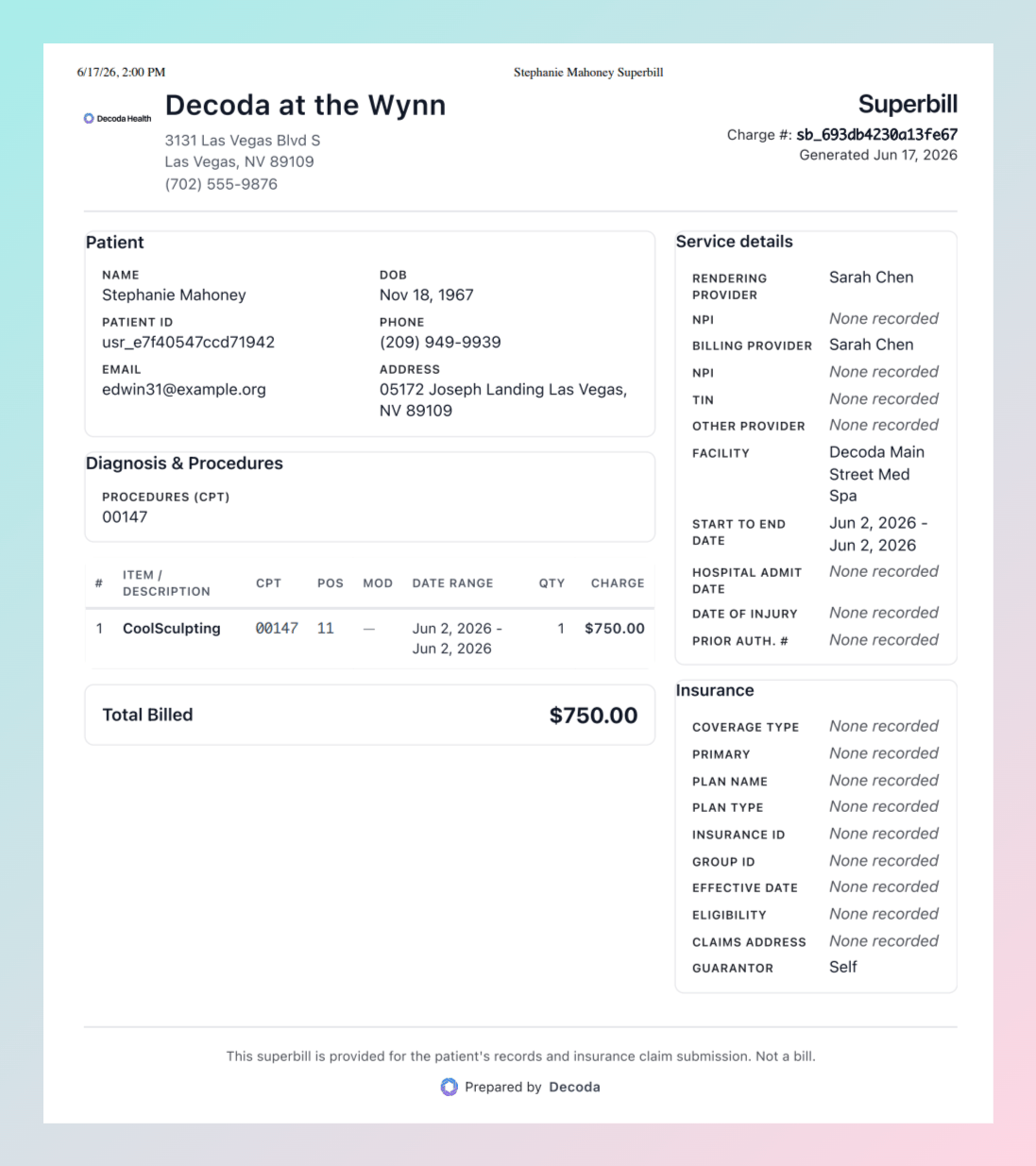
A finished Super Bill ready to print or email to the patient.
Drag Appointments to Reschedule, Including on iPad
Pick up any appointment in Day or Week view and drop it on a new time — Decoda asks once whether to text the patient. The interaction works on iPad with a press-and-hold, and in Day view you can drop into a different provider’s column to switch providers in the same move. See Drag to a new time.Require Intake Forms Before Patients Can Check Themselves In
If an appointment’s service has required forms, the kiosk and patient portal block self check-in until the patient submits every form, with a clear Complete your forms to enable check-in prompt. Staff can still mark the patient checked in from the calendar or sidebar; the Daily Dashboard surfaces a Send Form action so the front desk can push the forms out first. See Forms Must Be Done First.Charge a Patient’s Existing Gift Cards at Checkout
When a patient has gift cards they bought or received, each one appears as a selectable row on the Gift Card payment method — no code typing needed. Outside cards can still be redeemed by entering the code manually. See Redeem a Gift Card.Charge No-Show Fees on Missed Appointments
Set a fixed or percentage No-show Fee in service settings. When staff mark an appointment as a no-show, Decoda asks whether to charge it. See Pricing & Payments on the services page.Filter Billing Dashboards by Promotion
The Promotion filter joins Product Sales Breakdown, Payment Breakdown, and Provider Earnings — pick a promotion to see only the charges, payments, or earnings tied to it. See Revenue Dashboards and Provider Earnings.Apply Manual Promotions With One Click
The checkout Promotions dialog now treats every eligible row — including code-gated promos the cart already qualifies for — as a click target. Hit the row to apply; the Enter promo code field is still there as a fallback. See How Promotions Appear at Checkout.Edit Phone-Number Schedules Right on the Weekly Timeline
The phone number detail page lets you paint, drag, resize, and delete a handler’s hours directly on the weekly grid instead of through a separate schedule form. See Edit Hours Directly on the Timeline.Skip the GFE Request When the Patient Already Has a Recent One
When a new appointment is booked for a patient who already has a Good Faith Exam covering the treatments and it’s still within its one-year validity window (and isn’t archived), the Request GFE checklist item is ticked automatically. The auto-skip looks at recency, not approval status, so staff should still glance at the GFE’s status badge before treatment. The step is also reordered before Checked In so the front desk can confirm coverage as soon as the patient walks in. See Spakinect Good Faith Exams.Browse Patient Documents as a Thumbnail Grid
A List / Grid view toggle on the patient’s documents tab switches between the existing list and a thumbnail grid — useful when most uploads are images. See Forms & Documents Tab.Hide Shift Capacity Behind a Toggle
When you create a shift, the Capacity field stays hidden until you turn on This shift can do more than 1 appointment at a time — so single-provider shifts no longer surface a setting that doesn’t apply. Existing shifts that already have a capacity above 1 open with the switch on. See Add a Shift.Show Shifts on the Calendar From the Event Types Filter
The Event Types sidebar filter now includes Shifts alongside Appointments and Blocks, so you can overlay shift events on the day or week grid. Shifts stay off by default; the Schedule view continues to hide them. See Filter the Calendar.Auto-Complete the Note Taken Checklist When a Note Is Signed
When a provider signs the first clinical note for an appointment, the Note Taken checklist item ticks itself. A manual tick by another staff member still wins if it happens first. See Appointment Checklists.Track Provider-Requested Appointments
The appointment form has a new The patient specifically requested this provider toggle, surfaced on the calendar with the Provider Requested icon and tracked in analytics so you can see how often patients ask for someone by name. See Book an Appointment.Paginate Through the Schedule With Load More Events
The Schedule view now anchors on the selected day and adds the next day each time you click Load more events at the bottom — handy for printing a multi-day roster without switching to Week view. See Calendar Views.Keep Earned Membership Benefits After Cancellation or Expiry
Membership discounts and credits are now gated by their own expiry and quantity rules — not membership status. Patients whose membership ends as Cancelled, Expired, Delinquent, or Inactive can still redeem anything they earned until those benefits hit their own expiry. Frozen memberships still pause benefits while billing is paused. See When membership benefits stop being redeemable.Jump From Global Search to a Filtered Catalog Page
Picking a catalog item from ⌘K search now opens the settings list pre-filtered to that one row, so you can see the highlighted item with one click to open it — or clear the filter to show everything. See Catalog Items.Annotations, Memberships, and Workflow Improvements
Edit and Erase Individual Annotations in Scribe
An eraser tool and per-mark editing let you target specific marks in the Scribe image annotator and remove or reposition them with precision.Take Bulk Action on Membership Rosters
On a membership’s detail page, select multiple members and apply a freeze, billing-date update, deactivation, or billing rerun to all of them in a single operation.Code-Required Promotions Apply at Checkout in One Click
Promotions that require a code and qualify for the current cart appear in the checkout promotions panel with a “Use” button for staff to apply in one click.Set Billing Codes on Products and Medications
A Billing Codes tab in the product and medication settings drawers lets you save default CPT codes, ICD-10 codes, and modifiers that pre-populate on superbills when those items are charged.Targeted Notifications for Each Checklist Step
Notification settings include an independent toggle for each appointment checklist step — check-in, forms, measurements, dose, payment, and more — so each team member subscribes only to the alerts that fit their role.Book a Service Multiple Times in One Appointment
An “Allow Multiple Bookings” toggle in service settings lets patients add the same service more than once to a single appointment, for workflows like multiple treatment areas booked together.Billing, Calling, and Workflow Improvements